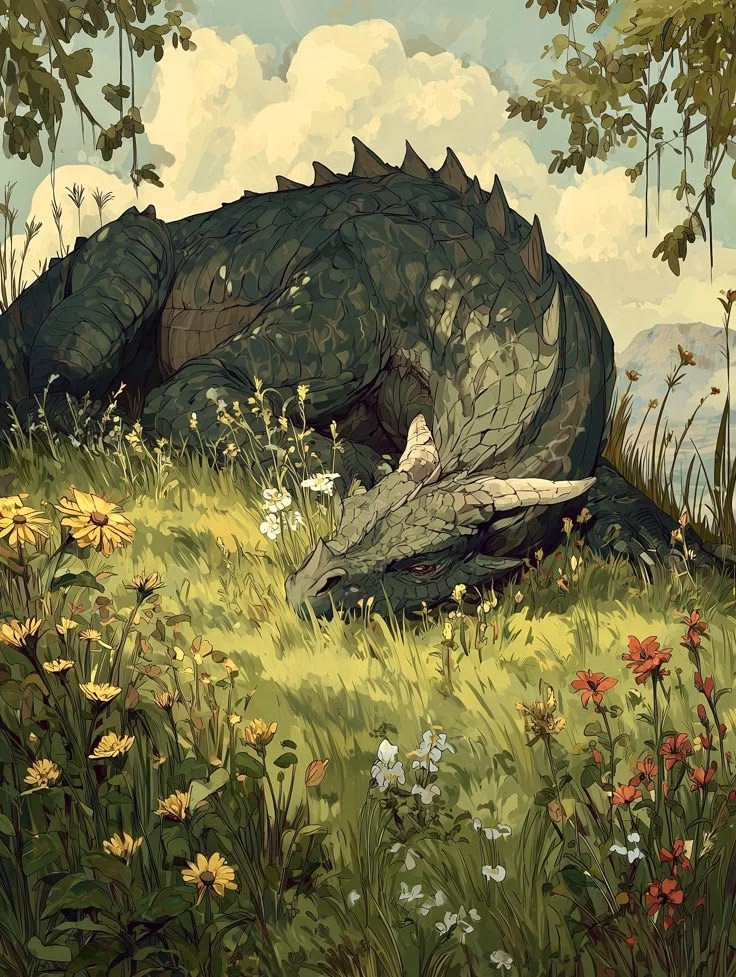
A Sir Whiskerton Story
Two dragons. One fire. And the long, slow evening that follows a goodbye.
Part One: The Arrival
The dragon came on a Tuesday, at the hour when the farm is at its softest — late afternoon, the light thinning, the day leaning into itself.
Longwei was in his usual spot, curled into a patch of sun that was fading but still warm, his tail wrapped around himself twice, his whiskers twitching at some dream he would not remember. He was purring. He was almost always purring.
The animals noticed the visitor before Longwei did. A shadow crossed the pasture — larger than a bird, larger than a cloud, slower than either. It came from the north, from the direction of the mountains, and it did not land on the farm the way Longwei landed on the farm. It arrived. It settled at the edge of the west field, where the pasture meets the wild wood, and it stayed there.
It was a dragon.
Not as large as Longwei. Older, though. You could tell from the way it held itself — the way an elder holds itself when it has stopped needing to prove anything.
The animals watched from a distance. Doris did not faint. Rufus did not bark. Even Sir Whiskerton, on his sunbeam on the barn roof, simply observed — his tail still, his monocle catching the last of the light.
And then Longwei woke up.
He raised his head slowly, blinking. He looked toward the west field. And something in his face changed — not shock, not surprise. Something older. Something that had been waiting.
He stood.
He did not fly. He walked. Slowly. Deliberately. The way you walk toward something you have known for a very long time.
The other dragon watched him come. When Longwei reached him, neither of them spoke. They simply looked at each other — the way two creatures look at each other when the words have already been said, years ago, at a school neither of them would ever forget.
And then the older dragon — An Yi — spoke first.
"You got fat," he said.
"I got content," Longwei said.
"Same thing."
They both laughed. Quietly. The way old friends laugh when the joke is not the joke.
Part Two: The Sunken Glade
An Yi did not want to stay in the west field.
"Take me somewhere quiet," he said. "Somewhere we can be."
Longwei did not ask where. He simply led. North, through the birch wood, past the trees so slender and white they seemed to glow even when the sky was grey. The ground sloped gently downward. The birches closed around them. And then they stepped into the Sunken Glade.
It was the same as it had always been. A shallow bowl in the earth, cupped by the land as if the world itself wanted to hold this place safe. Granite boulders, rounded by time, warm to the touch. Wild grasses between the stones. Blueberry bushes at the edges. And the light — the light that made the glade bright even on cloudy days, softer than sunlight but present, the kind of light that seemed to come from the birches themselves, as if they had been keeping it for someone.
An Yi stopped at the rim. He looked around. He inhaled.
"This," he said, "is a good place."
"It is," Longwei said.
"A very good place."
"It is."
"I think I could stay here for a while."
Longwei did not answer. He did not need to.
The rabbits watched from their warrens. They did not approach. They did not hide, either. They simply noticed — the way they notice everything, and remember everything, and say nothing at all.
Part Three: The Fire
They built the fire together.
Not built, exactly. There was no wood to gather, no tinder to arrange, no match to strike. They simply breathed. Two dragons, side by side, facing a patch of bare earth at the center of the glade. And when they exhaled — slowly, deliberately, with the patience of creatures who had learned this as children — the fire arrived.
It was not a large fire. It was contained. Warm. Orange-gold, the color of the light that comes through a window in the late afternoon. It did not spread. It did not threaten. It simply was — a small, glowing presence at the heart of the glade, throwing shadows against the boulders, catching the silver in Longwei's mane and the age in An Yi's scales.
They sat beside it. Neither spoke for a long time.
And then An Yi started to talk.
He talked about dragonhood school — the one they had both attended, decades ago, when the two of them had been pups. They had been terrible students, both of them. Longwei had spent most of his classes napping in the back of the cave. An Yi had spent most of his arguing with the instructors. They had not been friends at first. They had been rivals. It had taken them three years to realize that they were the same kind of dragon — the kind who did not fit the shape they had been given.
"I remember the day you set fire to the practice field," Longwei said.
"I did not set fire to the practice field."
"You did."
"I singed it."
"You set fire to it."
"I set fire to most of it."
They laughed again. Older now. The laugh was slower. But it was still the same laugh. It was still their laugh.
They talked about other things, too. About the dragons they had known. About the ones who had already moved on. About the ones who had not moved on, and were still somewhere, somewhere far off, living whatever lives dragons live when they choose to stay. About the small things. The warm things. The things that do not matter in any ledger or on any stone, but that stay — the taste of a particular mountain stream in the summer of a particular year, the sound of a friend's purr on a cold night, the shape of a cloud that had looked, for one absurd moment, exactly like a fish.
An Yi talked more than Longwei did. That was always how it had been. An Yi had always been the one who talked. Longwei had always been the one who listened. And in all the years since dragonhood school, nothing between them had ever changed.
The rabbits listened from their warrens. They did not move. They did not need to.
Part Four: The Watching
On the rim of the glade, at the top of the slope where the birches thinned, the animals of the farm had gathered.
They had come one by one, drawn by something they could not name. Doris the Hen stood beside Harriet and Lillian. Bessie the Cow stood with her mood ring glowing a soft, deep indigo. Porkchop the Pig sat heavily on the grass, his Hawaiian shirt bright in the fading light. Rufus the Dog stood with his glow dimmed — deliberately, quietly, as if he had chosen not to shine. Sir Whiskerton sat apart, on a low boulder at the edge of the trees, his tail wrapped around his paws, his monocle catching the firelight from below.
No one spoke. No one moved.
They had not come to help. They had not come to intervene. They had come to witness. Because a dragon was moving on, and witnessing was the only thing the farm knew how to do — the only thing that was right.
Sir Whiskerton watched the two figures at the center of the glade. He watched the fire. He watched the slow way Longwei leaned toward his friend, and the slower way An Yi leaned back.
And he understood — with a clarity that did not need to be spoken — that this was not a crisis. This was not a mystery to solve. This was not a problem. This was something else. Something older. Something that required nothing but presence.
So he stayed. So they all stayed.
Part Five: The Hardening
It happened slowly. So slowly that at first, Longwei did not notice.
An Yi was talking — about the time they had flown to the coast together, when they were young, and had found a cove where the water was so clear you could see the fish thinking. And then he stopped. Mid-sentence. His eyes were still open. But he was not there.
Longwei waited. This was not new. An Yi had been drifting for weeks. It was the way of a dragon who was moving on. The body tires before the spirit does. The spirit wanders, and then comes back, and then wanders again, and each wander takes a little longer.
An Yi came back. He blinked. He looked at Longwei. "Where was I?"
"The cove."
"Ah. The cove." He smiled. "There was a fish. A very serious fish. It looked at us like we owed it money."
"Yes."
"I liked that fish."
"So did I."
An Yi drifted again. This time he did not come back as quickly. And when he did come back, something was different. His scales were harder. Not cold. Not dry. Just firmer — the way a shell firms up, the way armor firms up, the way a thing that is about to change firms up in preparation for the change.
Longwei put his paw on An Yi's shoulder. It was the only touch he had offered the entire evening. He did not need to do anything. He simply placed his paw there, and left it there, and did not move it.
An Yi looked at him.
"I'm not afraid," he said.
"I know."
"I was, for a while. Weeks ago. And then —" He paused. He seemed to be searching for the right word. "And then I wasn't."
"That is how it goes," Longwei said.
"Yes." An Yi's eyes were on the fire. "That is how it goes."
He leaned into Longwei's paw. His breath was slower now. His eyes were half-closed.
"It was a good life," he said.
"It was."
"A very good life."
"It was."
"Thank you for coming with me."
Longwei did not answer. He could not. He simply nodded — one small nod — and kept his paw on An Yi's shoulder, and watched the fire, and did not look away.
Part Six: The Smoke
The moment came in the pause between two breaths.
An Yi's eyes closed. His chest rose — slowly, gently, the way it had risen a thousand times before. And then it did not rise again.
His body did not fall. It simply settled — into the ground, into the earth of the glade, into the shape it had been moving toward for weeks. His outer shell grew harder. It was not rigid. It was not stone. It was simply finished — a shell that had done its work, and was now ready to be left behind, the way a snake leaves a skin, the way a tree leaves a leaf.
Longwei's paw was still on An Yi's shoulder. He did not move it. He did not need to.
And then, from between the scales of An Yi's chest — from a place inside the shell that had, a moment before, held a living dragon — a smoke emerged.
It was thin at first. A single thread. Then another. Then they twisted together, the way smoke twists, the way a rope twists, the way two friends who have known each other for a very long time twist into a single shape when they are no longer separate.
The smoke was grey. Not black. Not white. Grey, the color of a charcoal coat, the color of old fangs, the color of a dragon who had been called my little toke. It rose from An Yi's chest, and it unfurled, and it stretched into a long, elegant whip — the shape of a dragon, the spirit of a dragon, the part of a dragon that does not live in the shell — and it began to drift around the fire.
It did not speak. It did not sing. It did not do anything, exactly. It simply was, and it moved, and it stayed, for a spell.
The animals on the rim of the glade watched it. They did not move. They did not whisper. They did not, in any way, intrude upon the goodbye. They simply watched — the way you watch a thing that is happening, and that you cannot help or change, and that you are glad to be present for, because being present is the only thing the moment asks of you.
The smoke whip curled around the fire once. Twice. Three times. It seemed to pause at a particular angle, the way a person pauses when they are about to turn and say one last thing. Longwei — who had not moved, who had not lifted his paw, who had not said a word — looked at it.
He did not say goodbye. He did not say I'll miss you. He did not say any of the things you are supposed to say at a moment like this.
He simply said: "I'll see you."
The smoke seemed to consider this. And then — slowly, gently, with the same patience it had shown all evening — it turned away from the fire, and lifted, and rose, and drifted.
It did not vanish. It did not disappear. It simply drifted, the way smoke drifts, on the evening breeze that had come up quietly while no one was watching. It passed over the boulders of the glade. It passed over the birches. It passed over the animals on the rim — Doris and Harriet and Lillian, Bessie and Porkchop and Rufus, Sir Whiskerton on his low boulder — and it did not stop, and it did not say anything, and it did not need to.
It simply went, the way all things go, the way evening goes, the way a good life goes, the way a friend goes when he has said what he came to say.
And then it was gone.
The fire burned on. The birches held their light. And Longwei remained, at the center of the glade, with his paw on a shell that was no longer his friend, and his eyes on the place where the smoke had been.
He did not cry. He did not not cry. He simply sat, the way he had sat a hundred times before, in a patch of sun or a patch of shadow, waiting for something he did not need to name.
The animals did not approach. They stayed on the rim. They would stay there for a while, and then, one by one, they would leave — not because they wanted to, but because the goodbye was over, and being present no longer meant staying.
Sir Whiskerton was the last to go. He did not leap down from his boulder. He did not walk toward Longwei. He simply looked, once, from his perch at the edge of the trees — and then he turned, and went back to the farm, and did not look back.
Part Seven: The Morning
Longwei was still in the glade when the sun rose.
He had not slept. He had not moved. The fire had burned down to embers, and the embers had faded to ash, and the ash had cooled, and still he sat.
His paw was still on An Yi's shell. The shell was warm — not because it was alive, but because it had been near a fire all night. Longwei did not remove his paw. He did not need to.
At some point in the night, the sky had cleared. The birches had brightened. And in the light of the early morning, the glade looked exactly as it always looked — beautiful, quiet, held. The rabbits had come out of their warrens and gone about their business. A bluejay had tested the air. The world had continued.
Longwei looked at the shell. He looked at the ashes. He looked at the place where the smoke had drifted. And then he stood up. Slowly. The way an old dragon stands, when he has been sitting for a very long time.
He did not remove the shell. He did not move it. He simply left it there — in the glade, on the soft earth, at the center of the circle of warmth that would no longer be needed. The rabbits would know what to do with it. They always did. They had been doing it for a long time.
Longwei walked back to the farm. Slowly. The way you walk when you have just said goodbye. The sun was on his scales. The birds were waking up. Somewhere in the distance, Doris was complaining about something — the sound of her voice carrying across the fields, familiar, steady, alive.
He stopped at the edge of the pasture. He looked back, once, at the birch wood. And then he lay down in his usual patch of sun — the patch that was his, that had been his for years — and he curled his tail around himself twice, and he closed his eyes.
He did not purr. But he did not not purr. He simply was. The way An Yi was being something else, somewhere else, on the evening breeze that had carried him away.
The farm went on. The way farms do.
And on the barn roof, Sir Whiskerton sat watching — the way he always watched, the way he had watched all night — and he did not move, and he did not speak, and he did not need to.
Because some goodbyes are not the end of something. They are simply what happens next.
Moral
The ones we love do not leave us. They change form. They become smoke on the evening breeze, and fire in the memory, and a shell left behind that the earth knows how to hold. The only thing we can do — the only thing the moment asks of us — is to be present. To watch. To stay. Not to stop what is happening, but to witness it. And when the smoke drifts away, to walk slowly home, and lie down in the sun, and let the world continue.
Best Lines
"You got fat." / "I got content." / "Same thing."
"This is a good place." / "It is." / "A very good place." / "It is." / "I think I could stay here for a while."
"I'm not afraid." / "I know."
"I was, for a while. Weeks ago. And then — and then I wasn't."
"It was a good life." / "It was." / "A very good life." / "It was."
"I'll see you."
"The ones we love do not leave us. They change form."
Featuring
Longwei the Dragon (龙喵) — the one who stayed, and the one who was left behind. His silence through the evening is the story's true voice. He does not try to fix what is happening. He does not try to stop it. He simply is present — with his paw on a friend's shoulder — for as long as presence is needed.
An Yi the Dragon (安逸 — "peaceful ease") — the friend who moved on. A dragon of Longwei's own generation, an old friend from elementary dragonhood school, who came to say goodbye and who left on the evening breeze. He is not afraid. He is not resigned. He is at peace — and his peace is the gift he leaves behind.
Sir Whiskerton (胡子爵士) — the witness. He does not solve anything. He does not interpret anything. He simply watches, from a low boulder at the edge of the glade, and then goes home, and lets the farm continue.
The Animals of the Farm — Doris, Harriet, Lillian, Bessie, Porkchop, Rufus, and the others — who gather on the rim of the glade in silence. They do not intrude. They do not speak. They witness — which is the only thing the moment asks of them.
The Rabbits of the Sunken Glade — who watch from their warrens, who do not approach, and who know what to do with the shell after the fire has gone out.
The Evening Breeze — the quiet, patient presence that carries An Yi away, and that was always there, even before the story began.
P.S.
There is no post-credit scene for this story. There are no key jokes. There is no afterward.
There is only this — the fire, the smoke, the walk home, the sun. And the simple, quiet truth that the ones we love do not leave us. They change form. They become smoke on the evening breeze. They become fire in the memory. They become the shape of a goodbye that was chosen, not forced, and that was witnessed, not interrupted.
Longwei did not try to keep his friend. He did not beg. He did not argue with the change. He simply sat with him, at the end of a long life, at the edge of a farm, in a glade where the birches hold light even on cloudy days.
And when the smoke drifted away, he did not follow it. He did not reach for it. He simply watched it go, and then he walked slowly home, and lay down in the sun.
That is the whole story. That is the whole message. That is what "moving on to the next phase of my life" means — for the one who leaves, and for the one who stays.
Jingle on.